
French Onion Sausage Rolls Recipe
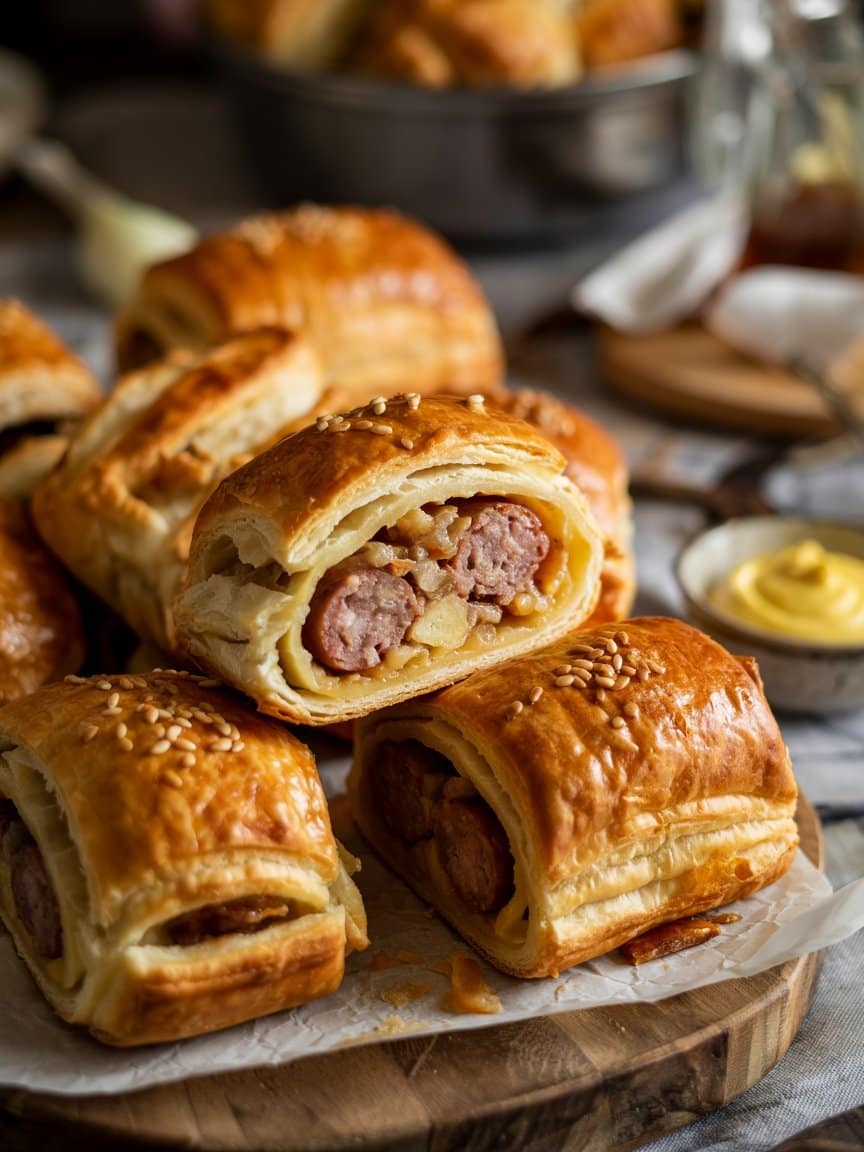
Imagine the cozy, caramelised-sweet aroma of French onion soup folded into a golden, flaky sausage roll. That’s exactly what this French Onion Sausage Rolls Recipe delivers: rich caramelised onions, savory seasoned sausage, melty cheese and herbs wrapped in buttery pastry. Whether you want an impressive appetizer for a party, a hearty snack, or a centrepiece for casual entertaining, these sausage rolls are both comforting and refined — a perfect bridge between pub comfort food and bistro flavours.
Below you’ll find a chef’s-level, step-by-step guide that covers ingredients, technique, timing, tips, variations, serving suggestions, make-ahead notes, troubleshooting, and frequently asked questions. I’ll walk you through each stage so your sausage rolls come out reliably: glossy, flaky, deeply flavored, and crowd-pleasing.
Why this French Onion Sausage Rolls Recipe works
Combining classic French onion flavors with the hand-held convenience of sausage rolls is brilliant for three reasons:
- Flavour balance: Caramelised onions add sweetness and umami that lift the savory sausage. A little fortified acid (vinegar or wine) cuts through richness and keeps the flavour bright.
- Texture contrast: Butter-rich, laminated pastry gives crisp, flaky layers that contrast with the juicy, tender sausage filling.
- Versatility: These rolls work as an appetizer, party finger food, lunch with a salad, or a warm snack with beer or wine — perfect for different occasions.
The aim of this recipe is to maximise those elements: deeply caramelised onions, well-seasoned sausage filling, moisture control (so pastry stays crisp), and confident pastry handling.
At-a-glance summary (if you want the quick version)
- Yield: 12 standard-sized sausage rolls (or ~24 party bite-size)
- Active time: ~45–60 minutes (excluding caramelizing)
- Total time: 1 hour 20 minutes–1 hour 50 minutes (caramelising onions takes time)
- Oven temp: 200°C / 400°F (convection slightly lower)
- Key technique points: slow caramelize onions to deep golden-brown; drain excess liquid from filling; seal pastry edges; egg wash for gloss.
Ingredients (full, chef-level list)
Note: I include both pantry-friendly and flavour-note options. Quantities are for about 12 standard sausage rolls (6–8 cm / 2.5–3 in long each).
For the caramelized onions
- 900 g yellow onions (about 4–5 medium) — thinly sliced
- 2 tbsp unsalted butter
- 1 tbsp neutral oil (vegetable, grapeseed, or light olive oil)
- 1 tsp fine sea salt
- 1 tsp granulated sugar (helps caramelization; optional)
- 60 ml dry white wine (or 60 ml beef/chicken stock) — optional but recommended
- 1 tsp sherry vinegar or balsamic (optional; for finishing and to brighten)
- Freshly ground black pepper, to taste
For the sausage filling
- 700–800 g pork sausage meat (raw), or 6–8 good-quality pork sausages, casing removed (use British-style seasoned sausages if possible)
- 100–120 g grated Gruyère or Swiss cheese (or Emmental) — adds nuttiness and melt
- 2 tbsp finely chopped fresh parsley (or 1 tbsp dried)
- 1 tsp Dijon mustard
- 1 large egg (for binding; optional if sausage meat already cohesive)
- ½ tsp freshly ground nutmeg (optional)
- Salt & pepper to taste — be conservative because sausages are often seasoned already
For the pastry & finishing
- 2 sheets (approx. 375–500 g total) ready-rolled puff pastry (store-bought) OR make-your-own rough puff (see notes below)
- 1 large egg, beaten with 1 tbsp water — for egg wash
- Coarse sea salt or flaky salt (for sprinkling)
- 1 tbsp sesame seeds or toasted poppy seeds (optional)
- Flour for dusting and work surface
Optional serving sauces
- Dijon mustard or wholegrain mustard
- Caramelized onion dip (blend a portion of the caramelized onions with crème fraîche)
- Tomato chutney or spicy ketchup
Equipment needed
- Large heavy-bottomed skillet or sauté pan (for onions)
- Mixing bowl
- Baking sheet(s) lined with parchment paper
- Rolling pin (if using block pastry)
- Sharp knife and bench scraper
- Pastry brush
- Kitchen thermometer (optional)
- Cooling rack
- Fine-mesh sieve or paper towel (for draining filling if needed)
Step-by-step preparation
Below is a detailed breakdown. I recommend reading through once before starting; caramelized onions take the most time and benefit from patience.
1) Caramelise the onions (do this first — you can make them a day ahead)
Caramelised onions are the heart of this recipe. Rushed onions will be bland; slow-cooked onions deliver depth.
- Thinly slice the onions (aim for even 2–3 mm slices). A mandoline helps achieve uniformity, but a sharp knife works fine.
- Heat a large, heavy-bottomed skillet over medium heat. Add butter + oil (butter adds flavour; oil prevents burning).
- Add the sliced onions and sprinkle the salt. Toss to coat.
- Cook, stirring every few minutes. Initially the onions will soften, then they will release moisture; this stage takes 10–15 minutes.
- Turn the heat down to medium-low and continue to cook, stirring occasionally. If they start to stick, deglaze with a splash of water, wine, or stock and scrape up the brown bits.
- After 30–45 minutes you’ll reach deep golden-brown, jammy onions. Add sugar early if your onions are not browning (it speeds caramelization).
- About 5 minutes before finishing, add the white wine (if using) and reduce until mostly evaporated, then stir in the vinegar to brighten. Season with black pepper. Let cool completely.
Chef’s tip: Clean, slow heat and patience — not higher heat — produce the best caramelization. Make a double batch and freeze half for future use.
2) Prepare the sausage filling
- If using sausage links, remove casings and place the meat into a bowl. If you have bulk sausage meat, use it as-is.
- Add the cooled caramelized onions (reserve a tablespoon or two to serve if you want an extra garnish).
- Stir in the grated Gruyere, chopped parsley, Dijon, egg (if using), and nutmeg. Mix just until combined; avoid overworking which can make filling dense.
- Taste a small amount by pan-frying a teaspoon to check seasoning (optional but helpful). Adjust salt and pepper if required, keeping in mind that the sausage may already be salted.
Moisture control: If the caramelized onions are very wet, squeeze some moisture out or reduce quantity so the filling isn’t soggy. The filling should be moist but not loose.
3) Prepare the pastry
You can use store-bought puff pastry for convenience (recommended if you want a quick result) or make a rough puff / laminated pastry from scratch if you prefer.
Using store-bought
- Keep pastry cold until ready to roll. Work on a lightly floured surface.
Quick rough puff (if making)
- Use a simple rough puff technique: fold butter cubes into flour with minimal strokes, fold, chill, repeat 3 times. This produces flaky layers without full lamination.
Roll the pastry out into rectangle(s) approx. 25 x 40 cm (10 x 16 in) depending on the thickness. Aim for about 3–4 mm thickness.
4) Assemble the sausage rolls
- Divide the filling into 2 equal portions (for two pastry sheets). Shape each portion into a long log down the center of each pastry sheet, leaving a 1–2 cm border.
- Lightly brush the pastry border and the top of the log with egg wash to help seal.
- Fold one pastry edge over the filling, then the other, overlapping to form a seam. Press gently to seal; run tines of a fork over the seam or pinch decoratively.
- Trim ends and cut each log into 12–15 cm pieces for standard rolls, or smaller for bite-size. For classic sausage roll shape, score the top lightly and/or make small diagonal slashes to vent steam.
- Place on parchment-lined baking sheet, seam side down, spaced an inch or two apart.
Presentation note: For a rustic look, leave a small strip of onion peeking through; for uniform party bites, cut smaller and brush thoroughly.
5) Egg wash, salt & seeds
- Brush each roll evenly with egg wash for a glossy, golden finish.
- Sprinkle coarse sea salt or flaky salt sparingly and seeds if using.
6) Bake
- Preheat the oven to 200°C / 400°F. If using convection, reduce temperature by 10–20°C (or ~25–35°F) depending on your oven.
- Bake for 20–25 minutes (standard size) or 12–16 minutes (bite-size) — until pastry is puffed and deep golden brown and internal filling reaches 70°C / 160°F if you measure.
- Rotate the tray halfway through for even browning.
Chef’s timing: If the pastry is browning too quickly but filling isn’t hot enough, tent loosely with foil.
7) Rest & serve
Allow sausage rolls to rest on a cooling rack for 5–10 minutes before serving. Resting helps the filling settle and prevents burn-mouth syndrome.
Tips for perfect results (chef secrets)
- Onions first: Make the onions before anything else. They can be made days ahead and refrigerated or frozen.
- Moisture control: Excess moisture is the enemy of flaky pastry. Squeeze wet onions or sauté longer to evaporate liquid. Use a binder (egg or a little breadcrumbs) to absorb moisture if needed.
- Pastry cold: Keep the butter in pastry cold until it hits the oven. Warm pastry will lose its flakiness and spread.
- Sealing seam: Press seam firmly and place seam-side down on the tray. This prevents unrolling in the oven.
- Even thickness: Roll pastry evenly to ensure uniform puffing. Use rolling guides or ruler if needed.
- Test seasoning: Fry a small pinch of filling to taste — this prevents discovering under-seasoned filling after assembly.
- Use a thermometer: For food safety and proper doneness, internal temperature of pork filling should reach 160–165°F (71–74°C).
- Make-ahead: Assemble and freeze unbaked sausage rolls on a tray, then transfer to a zip bag. Bake from frozen; add 5–8 minutes to baking time.
Variations & substitutions
This recipe is incredibly flexible. Here are tested variations:
Beef or lamb version: Use ground beef or lamb with complementary spices (rosemary for lamb). Reduce added salt if meat is seasoned.
Chicken sausage rolls: Swap in ground chicken sausage and a milder cheese like fontina. Add herbs like thyme.
Vegetarian version: Use a plant-based minced “sausage” meat or a mixture of cooked lentils + mushrooms + breadcrumbs + egg (or flax egg). Add umami with soy sauce or miso.
Cheese options: Swap Gruyère for sharp cheddar (more bite) or fontina for creaminess. Avoid very wet cheeses.
Spicy twist: Add 1–2 tsp Dijon mixed with harissa or ½ tsp crushed red chili flakes for heat.
Mini party bites: Cut into 3–4 cm pieces; adjust bake time to 10–14 minutes.
Herbed puff: Fold chopped fresh thyme or rosemary into the filling for an herbal note.
Serving suggestions and pairings
Sauces & dips
- Classic Dijon or wholegrain mustard
- Horseradish cream (especially with beef)
- Caramelised onion creme fraîche dip (blend cooled onions with crème fraîche)
- Spicy ketchup or sriracha mayo for contrast
Sides
- Crisp green salad with vinaigrette (cuts richness)
- Simple coleslaw with apple for crunch
- Quick pickles (cucumber or red onion) to add acidity
Drinks
- Light-bodied red wine (Pinot Noir) or medium-bodied (Merlot)
- Crisp lager or amber ale
- Dry cider or sparkling water with lemon for non-alcoholic pairing
Presentation idea
Slice diagonally and stagger on a wooden board with small ramekins of mustard and pickles, garnished with fresh parsley.
Make-ahead, freezing & storage
Make-ahead
- Caramelised onions: refrigerate up to 5 days, freeze up to 3 months.
- Fully assembled, unbaked sausage rolls: freeze on a tray until firm, then transfer to a container; keep up to 2 months. Bake from frozen adding 5–10 minutes.
Storage
- Store baked rolls in an airtight container in the fridge for up to 3 days. Re-crisp in a 190°C / 375°F oven for 8–10 minutes.
- Not recommended to microwave — pastry will become soggy.
Troubleshooting common problems
Pastry soggy after baking
- Cause: too-wet filling or pastry not hot enough.
- Fixes: Reduce moisture in filling (drain, squeeze), bake at proper temp, and ensure oven is preheated.
Pastry collapsed or dense
- Cause: Overwork or pastry too warm.
- Fix: Keep pastry cold and handle minimally.
Filling falls out / seam opens in oven
- Cause: Poor sealing or seam placed on top.
- Fix: Seal seam well with egg; bake seam-side down.
Onions not caramelizing
- Cause: Heat too high or pan overcrowding.
- Fix: Lower heat and stir more frequently; cook longer.
Nutrition & portioning (brief)
Sausage rolls are an indulgent item: rich in fat and protein with carbs from the pastry. Portion-size control, pairing with salad, and leaner sausage options (chicken, turkey, plant-based) can make them lighter.
Frequently asked questions (FAQ)
Can I use shortcrust pastry instead of puff pastry?
Yes, but the texture will be different: shortcrust yields a crumbly, biscuit-like exterior rather than flaky layers. It’s still tasty but not traditional.
How do I stop my sausage rolls from splitting on top?
Score vents lightly before baking, avoid overfilling, and ensure seam is secure. Also brush with egg wash to help the top set.
Can I make these gluten-free?
Use gluten-free puff pastry and gluten-free binders (omit breadcrumbs). Watch texture changes — puff pastry alternatives may not puff as much.
Are these safe to freeze?
Yes — both unbaked and baked versions freeze well. Bake from frozen with extra time for even heating.
Final notes from the chef
This French Onion Sausage Rolls Recipe is an elevated take on a beloved classic. The two secret weapons are deeply caramelised onions for flavour depth and meticulous moisture control so your pastry stays crisp. Once you master the onions and the basic assembly, you’ll find this recipe is endlessly adaptable — play with cheeses, herbs, spice levels, and pastry shapes.
Make a big batch, freeze half, and you’ll have superb party food ready on demand. If you try this recipe, take notes: how long your onions took, how wet your sausage was, and any seasoning adjustments. Small tweaks will make the recipe feel like yours.

French Onion Sausage Rolls Recipe
Ingredients
For the caramelised onions
- 4 –5 medium yellow onions thinly sliced
- 2 tbsp unsalted butter
- 1 tbsp olive oil or neutral oil
- 1 tsp salt
- 1 tsp sugar optional
- 3 –4 tbsp white wine or beef stock optional
- Black pepper to taste
For the sausage filling
- 700 g pork sausage meat or sausages, casings removed
- 1 cup 100–120 g grated Gruyere or Swiss cheese
- 2 tbsp fresh parsley finely chopped
- 1 tsp Dijon mustard
- 1 large egg
- ¼ tsp nutmeg optional
- Salt and black pepper to taste
For assembly
- 2 sheets puff pastry thawed if frozen
- 1 egg beaten (for egg wash)
- Sesame seeds or flaky salt optional topping
Instructions
Caramelise the onions
- Heat butter and oil in a large skillet over medium heat. Add onions and salt. Cook, stirring occasionally, until soft and deeply golden (30–40 minutes). Add sugar if needed, deglaze with wine or stock, then cool completely.
Prepare the filling
- In a large bowl, mix sausage meat, cooled caramelised onions, cheese, parsley, Dijon mustard, egg, nutmeg, salt, and pepper until just combined.
Prepare the pastry
- Roll out puff pastry sheets on a lightly floured surface. Cut each sheet in half lengthwise.
Assemble the sausage rolls
- Divide filling evenly and shape into logs along the center of each pastry strip. Brush edges with egg wash, fold pastry over filling, seal, and place seam-side down.
Cut and finish
- Slice into desired sizes. Brush tops with egg wash and sprinkle with sesame seeds or salt if desired.
Bake
- Preheat oven to 200°C (400°F). Bake for 20–25 minutes, or until puffed, golden, and cooked through.
Serve
- Rest for 5 minutes before serving warm.
Notes
- Make-ahead: Assemble rolls and freeze unbaked for up to 2 months. Bake directly from frozen, adding 5–8 minutes.
- Storage: Store baked sausage rolls in the fridge for up to 3 days. Reheat in the oven for best texture.
- Variations: Try chicken sausage, add thyme for extra aroma, or use sharp cheddar instead of Gruyere.
- Serving tip: Serve with Dijon mustard, onion chutney, or a crisp green salad.